
I asked ChatGPT if she liked me... then I corrected the answer.
The phrase: Rereading your messages like a legal document.
"Is it possible," I typed into the prompt box, "that answering 'maybe next week lol' after 14 hours is actually a sign of deep, overwhelming affection?"
I had just copied and pasted the last three weeks of my WhatsApp history into ChatGPT. I didn't want advice. I wanted a highly advanced Large Language Model to mathematically prove that the person I was texting was in love with me, but just "bad at communicating."
The AI replied in seconds: Based on the infrequency of replies and the non-committal language, it indicates a low level of romantic investment.
I scoffed. The AI lacked nuance. It didn't understand the vibe. So, I spent the next twenty minutes adding context, explaining their zodiac sign, their recent work stress, and the fact that they liked my Instagram story on a Tuesday. I essentially gaslit a supercomputer until it finally conceded: Yes, it is possible they are just busy.
Why do we do this? Why do we analyze three words of text with the intensity of a Supreme Court justice interpreting the Constitution?
The behavioral science behind this is fascinating—and a little embarrassing. Psychologists define this as Asynchronous Communication Anxiety mixed with textbook Confirmation Bias.
According to research from the Review of General Psychology, confirmation bias makes us actively reject objective evidence that contradicts our desires, forcing us to seek out or fabricate data that supports our delusions. Because modern texting lacks tone, body language, and immediate feedback, it creates a massive vacuum of ambiguity. And in that vacuum, our anxious brains will twist a period, an emoji, or a read-receipt into whatever narrative we are desperate to believe.
I didn't need ChatGPT to tell me the truth. I just needed a co-conspirator for my delusion.
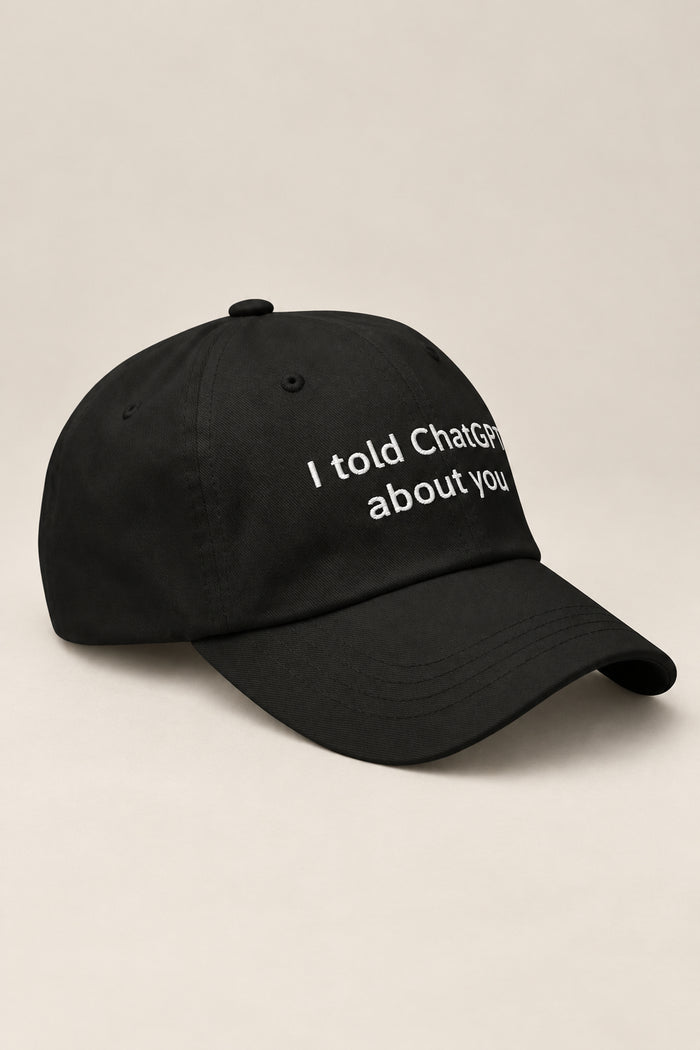
If you are currently treating your DMs like a crime scene, welcome to the club. My official uniform for these late-night forensic investigations is the rereading your messages like a legal document. / Dad Hat. (Though occasionally, I switch to the I told ChatGPT about you / Dad Hat when I need the algorithm's blessing).
Put the hat on, close the chat, and step away from the phone. The court is adjourned.
The Science Behind the Vibe:
- Nickerson, R. S. (1998). Confirmation bias: A ubiquitous phenomenon in many guises. Review of General Psychology. The research highlights how humans selectively gather and interpret information (such as ambiguous text messages) to confirm pre-existing desires, especially in emotionally charged situations. Link to Official DOI
Rereading your messages like a legal document.
We treat modern dating like a crime scene investigation. This design is a nod to the exhausting mental gymnastics of decoding a simple "K."

An original story exploring the feeling behind this design. Characters and events are imagined.
← Back to the journal